How to Size Soffit Vents: Step-by-Step for Homeowners
Size soffit vents correctly using IRC R806.2, covering real NFA ratings, a worked 2,100 sq ft example, and step-by-step measurement tips.
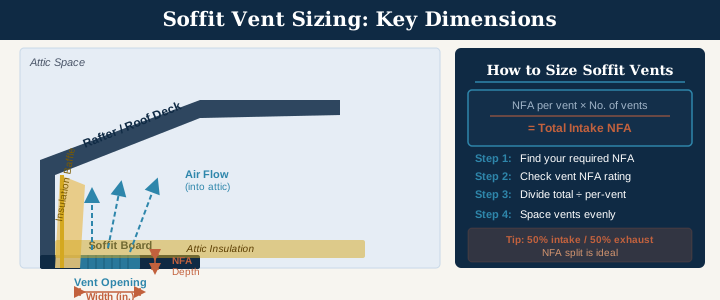
What Soffit Vents Actually Do
Soffit vents are the intake side of your attic's ventilation system. They sit along the underside of your roof overhang (the soffit) and pull outside air into the attic space. That fresh air then travels upward toward the ridge, where exhaust vents push it out.
Without adequate intake venting, exhaust vents can't function. Even a full continuous ridge vent is useless if the soffit is blocked or undersized. Think of it like a straw pinched at one end: nothing moves through the other end, no matter how wide it is.
The intake-to-exhaust balance is the point most homeowners get wrong. You can have 800 square inches of ridge vent on your roof and still have a moisture-damaged attic if you only have 150 square inches of soffit NFA feeding air in. The exhaust side creates a slight negative pressure that draws air from below, but only if there's enough opening to draw through.
Types of Soffit Vents and Their NFA Ratings
There are three main product types, and they perform very differently per dollar and per square foot of soffit.
Individual rectangular soffit vents are what you'll find stacked on the shelf at any hardware store. A standard 8x16 individual vent has a gross opening of 128 sq in, but its net free area (NFA), the actual air-permeable opening, runs 45–56 sq in depending on the manufacturer. The louver blades and wire mesh screen consume roughly half the gross area. Some budget vents drop as low as 38 sq in NFA on an 8x16 frame. Don't assume they're all equal.
Continuous soffit vents run as a long strip along the eave. A 16-inch-wide continuous vent delivers approximately 9 sq in of NFA per lineal foot. A 24-inch-wide version bumps that to about 14 sq in per lineal foot. They're more work to install but create uniform airflow along the full eave length, eliminating the dead zones that appear between individual vents.
Perforated soffit panels are integrated into the panel material itself. NFA per panel ranges from 3 to 12 sq in depending on the perforation pattern and panel size. Check the manufacturer's data sheet for each specific product. Many vinyl soffit panels are advertised as "vented" but deliver only 3–5 sq in of NFA per panel, which is far less than most homeowners expect.
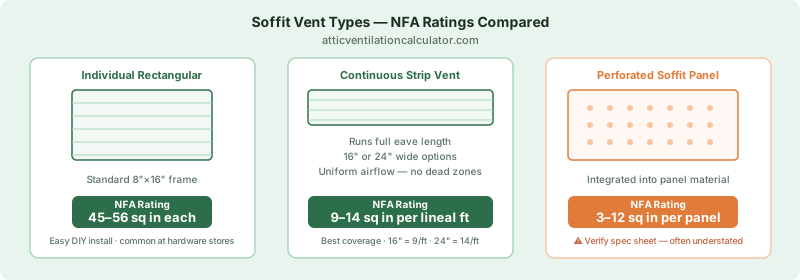
Here's a quick reference for planning your system:
- 8x16 individual soffit vent: 45–56 sq in NFA
- 6x16 individual soffit vent: 30–42 sq in NFA
- 16" wide continuous soffit vent: ~9 sq in NFA per lineal foot
- 24" wide continuous soffit vent: ~14 sq in NFA per lineal foot
- 8" wide continuous soffit vent: ~4–5 sq in NFA per lineal foot
Always pull NFA from the product packaging or the manufacturer's spec sheet. Two products with identical outside dimensions can differ by 30–40% in actual NFA based on screen mesh density and louver angle.
How to Calculate How Much Soffit Venting You Need
IRC Section R806.2 sets the baseline: you need 1 square foot of net free area for every 150 square feet of attic floor area. That's the 1/150 rule, and it's the standard most inspectors apply unless you have a verified vapor barrier on the warm side of the ceiling insulation. With a qualifying vapor barrier, the ratio drops to 1/300, but 1/150 is the safe default if you're unsure.
Total NFA gets split between intake and exhaust. The standard is 50/50: half your total NFA from soffit intake, half from ridge or roof vents as exhaust. Some building codes permit up to 60% exhaust / 40% intake, but a balanced split performs most consistently and is what the calculator assumes by default.
Worked example: 2,100 sq ft attic floor area
- Total NFA required: 2,100 ÷ 150 = 14 sq ft → 14 × 144 = 2,016 sq in total NFA
- Intake NFA needed (50% of total): 2,016 ÷ 2 = 1,008 sq in
- Exhaust NFA needed (50% of total): 1,008 sq in
Now translate that 1,008 sq in intake requirement into actual products:
- Using 16" continuous soffit vent (9 sq in NFA/ft): 1,008 ÷ 9 = 112 lineal feet of continuous vent
- Using individual 8x16 vents at 56 sq in NFA each: 1,008 ÷ 56 = 18 → 18 vents
So a 2,100 sq ft attic needs either 112 lineal feet of 16" continuous soffit vent, or 18 individual 8x16 vents evenly distributed around the eave perimeter.
For a 42x50-foot two-story, the full eave perimeter is about 184 lineal feet. A 112-foot continuous run is roughly 61% of that perimeter, achievable but tighter than it looks on paper. You don't need vent everywhere, just enough to hit your NFA target, spaced so airflow covers the full attic.
Use the attic ventilation calculator to run your own square footage through this formula. It outputs both continuous footage and individual vent count automatically.
Measuring Your Soffit for Installation
Get a tape measure and walk the full perimeter of your house before you buy anything.
Start by measuring total eave length where soffit exists. On that 40x30-foot ranch, you've got about 140 lineal feet. But you can't use all of it. Subtract for garage walls that don't have soffits, porch headers that block the bay, downspout locations, and any corners where cutting isn't practical. Budget for 70–80% of total eave length being usable for vent placement.
Measure soffit depth next, which is the distance from the house wall to the outer fascia. Most residential soffits are 12–24 inches deep. You need at least 8 inches of clearance to install a standard individual vent. If yours are only 6 inches, shift to a 4" or 6" continuous vent instead.
Check the rafter bay depth above the soffit. In older homes, blown-in insulation has often migrated all the way to the eave line. A soffit vent cut into perfectly good material won't move any air if the rafter bay directly above it is packed with cellulose. You need to install rafter baffles (sometimes called vent chutes) first. These are foam or cardboard channels that hold a clear airway from the soffit opening up past the insulation line to the open attic space.
Mark all your vent locations with chalk before cutting. For individual vents, target one per rafter bay, centered in the soffit panel. For continuous vents, snap a chalk line 2 inches wide down the center of the soffit run. Drill starter holes at the cut corners, then cut with a jigsaw. A sharp blade and a slow feed rate keeps the cut clean.
Common Soffit Vent Mistakes
Confusing frame size with NFA rating. The soffit-vent aisle is full of products labeled by outside dimensions, which makes it tempting to compare products visually. Don't. Two 8×16 soffit vents sitting on the same shelf can differ by 30–40% in their actual NFA depending on mesh density and louver pitch. Always work from the manufacturer's rated NFA, never the frame size. Our NFA explainer covers how to read the spec sheet and spot understated ratings on budget products.
Uneven placement. Installing all your vents along one side of the house because that's the easy side creates airflow that sweeps across only part of the attic. The far side gets no fresh air movement, and moisture accumulates there. Distribute vents as evenly as possible around the full perimeter: north, south, east, and west eaves.
Insulation blocking rafter bays. This is the single most common issue in homes older than 20 years. Even 2–3 inches of blown-in insulation at the outer edge of a rafter bay seals the vent completely. The fix is baffles installed before the new insulation or blown-in top-up goes in. If you're adding attic insulation and upgrading vents at the same time, do the baffles first.
Treating soffit NFA as total ventilation. Soffit vents cover only intake. You still need an exhaust path of equal NFA, such as ridge vent, off-ridge vents, or roof louvers. A homeowner who installs 11 individual soffit vents (616 sq in NFA) and then stops, thinking the job is done, has completed only half the system. The ridge vent vs gable vent comparison covers the exhaust side in detail.
Skipping the vapor barrier check. If your attic has a qualifying vapor barrier, you need half the NFA the 1/150 rule demands. Using 1/150 when 1/300 applies means you're doing more work than necessary. If you're not certain what's on your ceiling plane, use 1/150. A small amount of over-ventilation is harmless in practice; under-ventilation is not.
Installing vs Upgrading Existing Soffit Vents
New installation is straightforward on wood or plywood soffits. Mark your locations, drill 3/8-inch starter holes at each cut corner, cut the opening with a jigsaw, clean up the edges, and screw the vent frame flush with the soffit surface. An experienced DIYer can install 12–15 individual vents in a half-day. Continuous vents take a bit longer because the slot cut needs to stay clean and consistent the full run.
For fiberglass or cement board soffits, use the appropriate blade, specifically a carbide-tipped jigsaw blade instead of a wood blade. These materials don't splinter, but they're brittle; clamp a backing board behind thin soffit material to prevent cracking as you cut.
Upgrading existing vents often means replacing older stamped-metal vents with low-NFA screens for higher-performing modern vents, or adding new cuts to get from an undersized total up to code. Before you start swapping product, calculate whether you have enough physical locations, or whether you need additional cuts along the soffit.
If your soffit doesn't have enough lineal footage to deliver the required NFA (common on a one-story house with narrow overhangs), consider these alternatives: switch to 24" continuous vent for higher NFA per foot, install a second row of individual vents on wider soffits, or supplement with undereave vents mounted just above the soffit plane on the wall framing.
When to call a contractor: If you have a vinyl or aluminum soffit system with integral panels, cutting into the panels is messy and can look bad. A siding contractor can re-panel your soffits with higher-NFA perforated material. Expect $400–$900 on a typical 1,400 sq ft ranch house depending on lineal footage and panel type. For wood or plywood soffits, though, this is a DIY-friendly job.
Get the math right before you cut anything. The free ventilation sizing tool gives you the target NFA split, and then you can convert that into product quantities using the NFA numbers in this guide.
If you're benchmarking against a typical house of your size, the ventilation requirements by house size guide breaks down intake and exhaust targets for homes from 800 to 3,000 sq ft. And if you want to understand exactly how to read the NFA specs on the products you're buying, the net free area explainer walks through AMCA testing, manufacturer labeling, and how to spot understated NFA claims on budget products.
Get Your Exact Numbers
Use our free IRC R806.2 calculator to find your required net free area.
Open Calculator →Related Guides
Ridge Vent vs Gable Vent: Which Is Better for Your Home?
Compare ridge vents and gable vents side by side, covering NFA ratings, installation costs, and whic…
Read guideNet Free Area in Attic Vents: What NFA Means and Why It Matters
NFA (net free area) is the actual airflow opening in your attic vents, not the gross hole size. Lear…
Read guideAttic Ventilation Requirements by House Size: A Complete Guide
Find out exactly how much attic ventilation your home needs based on square footage, with real NFA c…
Read guide