Ridge Vent vs Gable Vent: Which Is Better for Your Home?
Compare ridge vents and gable vents side by side, covering NFA ratings, installation costs, and which exhaust type actually works best for your roof style.
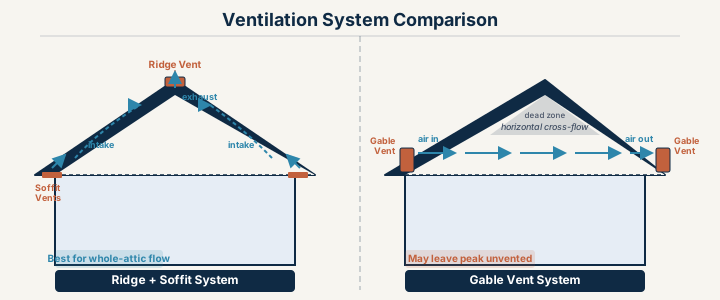
How Ridge Vents Work
A ridge vent runs along the peak of your roof, the full length of the ridge line. It's a low-profile slot cut into the sheathing right at the top, covered by a mesh-backed vent strip and then capped with shingles. From the ground, you can barely see it, which is one reason homeowners like it.
The physics are sound. Hot air accumulates at the highest point in the attic. Ridge vents sit exactly there, letting that air escape continuously along the entire roofline. They work passively, with no motor, no moving parts, and no electricity. As long as you pair them with adequate soffit intake, they create a reliable thermal convection loop year-round.
Most continuous ridge vents are rated at 17–18 square inches of NFA per lineal foot. That figure varies slightly by manufacturer and product line. GAF ShingleVent II runs about 18 sq in/ft, while some budget products drop to 14–15. Always check the spec sheet, not just the box.
How Gable Vents Work
Gable vents are mounted in the triangular end wall (the gable) of your attic, usually near the peak. They're louvered or screened openings that allow cross-ventilation: wind blows in one gable and out the other.
A standard louvered aluminum gable vent in a 14"×16" frame gives you roughly 100–115 square inches of NFA. Step up to an 18"×24" unit and you're looking at 180–220 sq in NFA. These are gross dimensions; the actual NFA is printed on the label because the louvers and frame reduce the open area significantly, often down to 50–60% of the overall size.
Gable vents rely heavily on wind. On calm days or when wind direction is perpendicular to the gable, they don't do much. They also don't serve the lower sections of the attic at all. A hip roof with no gable wall simply can't use them.
The Problem With Mixing Ridge and Gable Vents
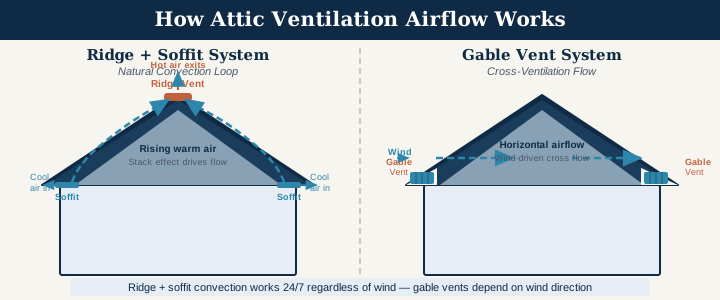
Here's where a lot of DIY ventilation projects go wrong: installing both ridge vents and gable vents simultaneously. It seems like more is better, but it's actually counterproductive.
When you have gable vents and ridge vents both open, wind blowing against a gable can pressurize that end of the attic and push air out through the ridge vent. That creates a short circuit: air moves from one gable to the ridge, completely bypassing the soffit vents. The lower two-thirds of your attic gets no fresh airflow at all.
The IRC doesn't explicitly ban the combination, but most roofing manufacturers do. Owens Corning, GAF, and CertainTeed all recommend not mixing exhaust types. If you go with ridge vents, close off or remove the gable vents. Plug the opening with matching siding, or install a decorative fixed cover.
If you need to keep gable vents for aesthetic reasons, pair them with soffit vents and skip the ridge vent, or accept that the system won't perform optimally.
NFA Comparison: Ridge vs Gable Per Lineal Foot
Let's run real numbers for a 1,500 sq ft attic at the 1/150 rule.
Required total NFA: 1,500 ÷ 150 × 144 = 1,440 sq in
At a 50/50 split: 720 sq in exhaust needed.
Option A: Ridge Vent Only
At 18 sq in per lineal foot: 720 ÷ 18 = 40 lineal feet of ridge vent
A typical 1,500 sq ft single-story has a 45–55 ft ridge line, so 40 lineal feet is usually achievable. You'd leave a few feet unvented near each end cap (standard practice is to stop 6–12 inches from the gable end to prevent short-circuiting).
Option B: Gable Vents Only
Using 18"×24" gable vents at 200 sq in NFA each: 720 ÷ 200 = 3.6 vents → 4 gable vents
Two gable vents (one per end) would give you 400 sq in, only 56% of the 720 sq in you need. You'd need to either upsize to larger units or add wall-mounted intake louvers to hit code. Gable vents also don't distribute ventilation evenly across the attic length the way ridge vents do.
For intake on the same house, you need 720 sq in of soffit venting. At 10 sq in per lineal foot of continuous soffit vent, that's 72 lineal feet, which is reasonable for a house with a full perimeter soffit.
Use the attic ventilation calculator to plug in your own square footage and see the vent count side by side.
Which Vent Type Fits Your Roof Style
Gable roofs are ideal for ridge vents. You've got a long, straight ridge and the geometry creates a natural thermal chimney from soffit to peak. This is the most common residential roof type in the US, and ridge vent + soffit vent is the gold-standard system for it.
Hip roofs have shorter ridges and four sloping sides with no gable walls. Ridge vents still work but give you less lineal footage to work with. You may need to supplement with off-ridge vents (box vents placed below the peak) or cobra vents on the upper third of each slope. Gable vents aren't an option at all.
Gambrel roofs (barn-style) have two ridge lines and steep lower slopes. Ridge vents go on the upper ridge; intake vents can go in the kneewall or the lower eaves. This is a custom situation worth reviewing with a contractor.
Complex roofs with multiple hips, valleys, and dormers need a system-by-system approach. Each isolated section of attic may need its own intake and exhaust pairing.
Low-slope roofs (under 2:12 pitch) don't work with ridge vents; there isn't enough height differential to drive convection, and the low profile makes installation impractical. Power ventilators or high-volume gable fans are more common here.
The net free area explained post goes into how to actually calculate whether your proposed vent products hit the NFA targets for your specific roof configuration.
Making the Right Call for Your Home
For most homeowners with a standard gable roof, continuous ridge vent paired with full-length soffit vents is the right answer. It's passive, low-maintenance, aesthetically clean, and performs reliably across all seasons. The upfront cost is slightly higher than gable vents. Expect $3–5 per lineal foot installed for ridge vent versus $80–150 per gable vent installed, but the performance advantage justifies it.
If your attic already has gable vents and you're adding insulation or re-roofing, that's the moment to upgrade. Pull the gable vents, cut in ridge vent along the full ridge length, and verify your soffit vent area is adequate. You'll get a meaningfully better system that'll last the life of the roof.
If you're not re-roofing and just need to add exhaust capacity cheaply, adding a second large gable vent is an option, but only if you don't have ridge vents installed. Never mix them.
Before buying anything, confirm your attic floor area and run the calculation. Our ventilation requirements calculator tells you exactly how many lineal feet of ridge vent or how many gable vents you need for your house. Then cross-check those numbers against the attic ventilation mistakes post to make sure you're not setting up a system that'll underperform from day one.
Get Your Exact Numbers
Use our free IRC R806.2 calculator to find your required net free area.
Open Calculator →Related Guides
How to Size Soffit Vents: Step-by-Step for Homeowners
Size soffit vents correctly using IRC R806.2, covering real NFA ratings, a worked 2,100 sq ft exampl…
Read guide8 Common Attic Ventilation Mistakes (And How to Avoid Them)
Most attic ventilation problems trace back to 8 preventable mistakes. Learn what they are, what dama…
Read guideNet Free Area in Attic Vents: What NFA Means and Why It Matters
NFA (net free area) is the actual airflow opening in your attic vents, not the gross hole size. Lear…
Read guide