Attic Ventilation Requirements by House Size: A Complete Guide
Find out exactly how much attic ventilation your home needs based on square footage, with real NFA calculations for common house sizes.
Why Your House Size Dictates Vent Requirements
The bigger your attic floor, the more air it needs to move. That's the core idea behind how attic ventilation is sized, and it's not just a rule of thumb. It's baked into the International Residential Code (IRC) Section R806.2, which most of the country follows.
Attic ventilation works by creating airflow that carries heat out in summer and moisture out in winter. Without enough vent area, that heat and moisture have nowhere to go. You end up with shingles that age faster, ice dams in cold climates, and mold growing on your sheathing. The fix isn't complicated once you know the numbers.
The starting point is always your attic floor area, the same footprint as your living space below. That number drives everything.
The IRC Formula: How Square Footage Drives NFA
The IRC gives you two options. The standard rule is 1/150, meaning for every 150 square feet of attic floor area, you need 1 square foot (144 square inches) of Net Free Area (NFA). NFA is the actual open space through which air can pass, not the gross vent size.
The second option is 1/300, which allows half as much total vent area, but only if at least 40% and no more than 50% of the required ventilation is in the upper portion of the attic (within 3 feet of the ridge), AND a Class I or Class II vapor retarder is installed on the warm-in-winter side of the ceiling.
The formula is straightforward:
Required NFA (sq in) = Attic Floor Area (sq ft) ÷ 150 × 144
Or for the 1/300 exception:
Required NFA (sq in) = Attic Floor Area (sq ft) ÷ 300 × 144
For a 1,500 sq ft attic using the 1/150 rule: 1,500 ÷ 150 = 10 sq ft, then 10 × 144 = 1,440 sq in total NFA required.
Most contractors apply a 60/40 intake-to-exhaust split for that 1,440 sq in: 864 sq in of intake (soffit vents) and 576 sq in of exhaust (ridge or roof vents). Some codes require a 50/50 split, so check your local amendment. Use our attic ventilation calculator to run this math for your specific home in seconds.
Attic Ventilation Requirements by Common House Size
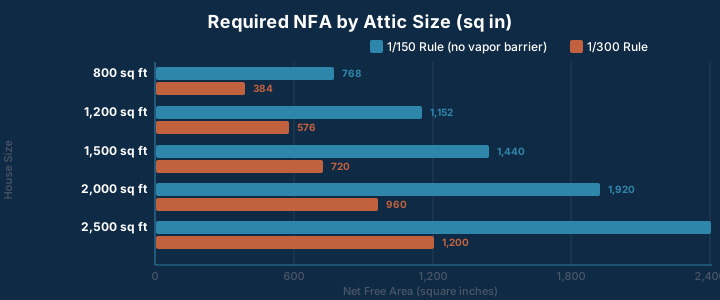
Here's the required NFA under both IRC ratios for five common house sizes. These assume the attic floor area equals the conditioned floor area, so adjust if your floor plan is split or irregular.
| Attic Floor Area | 1/150 Rule (NFA sq in) | 1/300 Rule (NFA sq in) |
|---|---|---|
| 800 sq ft | 768 sq in | 384 sq in |
| 1,200 sq ft | 1,152 sq in | 576 sq in |
| 1,500 sq ft | 1,440 sq in | 720 sq in |
| 2,000 sq ft | 1,920 sq in | 960 sq in |
| 2,500 sq ft | 2,400 sq in | 1,200 sq in |
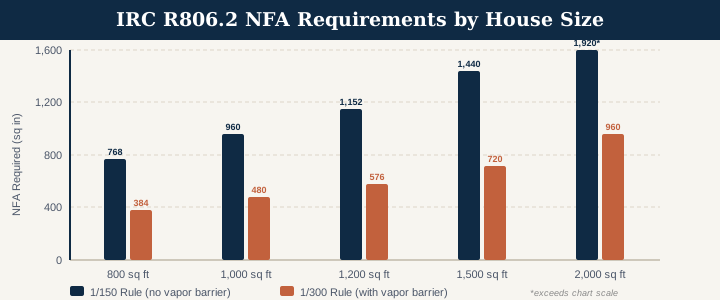
The 1/300 rule sounds appealing because it means fewer vents or smaller vents, but the vapor retarder requirement is a real condition, not just a checkbox. If your existing ceiling doesn't have a proper vapor retarder installed, you need to meet the 1/150 standard. Most older homes default to 1/150.
The net free area calculation explained post walks through exactly how NFA differs from vent dimensions, which matters a lot when you're shopping for specific products.
Intake vs Exhaust: Breaking Down the Split
You can't just stuff all your ventilation at the ridge. The IRC requires that ventilation be distributed: intake low (at the soffits) and exhaust high (at or near the ridge). This creates the stack effect: warm air rises and exits at the top, drawing cooler replacement air in from below.
The standard target is 50% intake, 50% exhaust. In practice, many roofing contractors aim for 60% intake, 40% exhaust because intake is often the limiting factor. Blocked soffits, inadequate soffit vent area, and insulation pushed against the eaves all choke the air supply.
For the 1,500 sq ft example above with 1,440 sq in total required:
- 50/50 split: 720 sq in intake + 720 sq in exhaust
- 60/40 split: 864 sq in intake + 576 sq in exhaust
If you can only hit the 50/50 split, that's code-compliant. The 60/40 leaning toward intake just tends to perform better in practice because it reduces the chance of negative pressure pulling conditioned air from the living space.
Never have more exhaust than intake. That creates negative pressure in the attic, which can pull conditioned air up through ceiling penetrations or even reverse-draw moisture into the space.
How Many Vents Do You Actually Need?
Once you have your total NFA numbers, you divide by the NFA rating of each vent you're installing. Every vent has a labeled NFA. It's on the packaging and usually stamped on the vent itself.
Here are typical NFA values for common vent types:
- Continuous ridge vent: 17–18 sq in per lineal foot (varies by brand)
- Round roof vent (turtle vent): 50–65 sq in each
- Rectangular soffit vent (16"×8"): 54–65 sq in each
- Continuous soffit vent strip: 9–11 sq in per lineal foot
- Gable end vent (18"×24"): 180–216 sq in each (net, not gross)
For the 1,500 sq ft house needing 576 sq in of exhaust: at 18 sq in per lineal foot of ridge vent, you'd need 32 lineal feet of ridge vent. That's a reasonable run for a typical gable roof.
On the intake side, 864 sq in at 10 sq in per lineal foot of continuous soffit vent means 86-90 lineal feet of soffit vent, or roughly 13–15 individual 16"×8" soffit vents (each ~65 sq in NFA) placed around the perimeter.
Run these numbers for your own home with the attic NFA calculator. It handles the splits and vent-count math automatically.
Getting the Right Count for Your Home
A few things can throw off a straight square-footage calculation. If your home has a finished bonus room or knee walls, the ventilated attic area is only the unfinished portion. Hip roofs have less ridge length than gable roofs, which limits ridge vent options and may require supplemental box vents.
Cathedral ceilings are a different situation entirely. They follow a different section of the IRC and typically require continuous baffles between each rafter bay. Don't apply these numbers to cathedral ceilings without checking with a local inspector first.
Also watch out for soffits that are too narrow for standard vent cutouts. Some older ranch homes have only 2–3 inch soffits, which can't accept the typical 16"×8" vent. In those cases, you'll need fascia vents or to add intake through over-fascia vent strips.
For most standard homes with gable or hip roofs and accessible soffits, the table above gives you a solid starting point. Cross-reference those numbers with your local building department's requirements. Forty-nine states have adopted the IRC, but local amendments can tighten or loosen these figures slightly. The IRC attic ventilation code explained post covers those local amendment considerations in more detail.
When you're ready to spec out an actual installation, the soffit vent sizing guide walks through picking the right intake products for your eave type and soffit width.
The right ventilation system doesn't have to be complicated. Know your attic floor area, pick your ratio, split it 50/50 or 60/40, and match up vent products to hit the numbers. Our free attic ventilation calculator does all of this in under a minute. Just enter your square footage and it gives you the full breakdown.
Get Your Exact Numbers
Use our free IRC R806.2 calculator to find your required net free area.
Open Calculator →Related Guides
Net Free Area in Attic Vents: What NFA Means and Why It Matters
NFA (net free area) is the actual airflow opening in your attic vents, not the gross hole size. Lear…
Read guideIRC Attic Ventilation Code: R806.2 Requirements Explained
IRC Section R806.2 sets the minimum attic ventilation standard for U.S. homes. Here's what the code …
Read guideHow to Size Soffit Vents: Step-by-Step for Homeowners
Size soffit vents correctly using IRC R806.2, covering real NFA ratings, a worked 2,100 sq ft exampl…
Read guide