Attic Ventilation Cost in 2026: Full Installation Breakdown
Get real 2026 pricing for attic ventilation installation, by vent type, house size, and DIY vs. pro, so you can budget before calling a contractor.
What Drives Attic Ventilation Costs
Attic ventilation pricing isn't one-size-fits-all. The final number on your quote depends on several variables that interact with each other, and knowing them upfront puts you in a better position when you're comparing bids.
Attic floor area is the primary driver. Larger attics require more net free area (NFA), which means more vent material and more labor. A 2,500 sq ft attic needs roughly 2,400 sq in of NFA under the 1/150 rule, about 3x the material of an 800 sq ft space.
Existing ventilation condition matters almost as much. If you're starting from scratch (no ridge vent, blocked soffits, one small gable vent from the 1970s), you're looking at a full system install. If you already have a functional ridge vent and just need soffit upgrades, costs drop significantly.
Roof access and pitch affect labor time directly. A 4:12 pitch is easy to walk; a 10:12 steep cut roof adds safety staging, time, and liability for the crew. Expect a 20–40% labor premium on steep roofs.
Your region affects both material costs and labor rates. A roofer in rural Iowa charges differently than one in suburban Boston. Get at least three local quotes for any job over $500.
Whether you're bundling with a re-roof is the biggest cost lever of all. If you're already tearing off old shingles, adding ridge vent costs almost nothing extra. The deck is exposed and the labor is already mobilized. If you're calling a roofer just to install ridge vent on an existing roof, you pay a mobilization premium.
Cost by Vent Type
Here's a breakdown of what each major vent type costs in 2026, including both material and typical installed pricing.
Continuous Ridge Vent
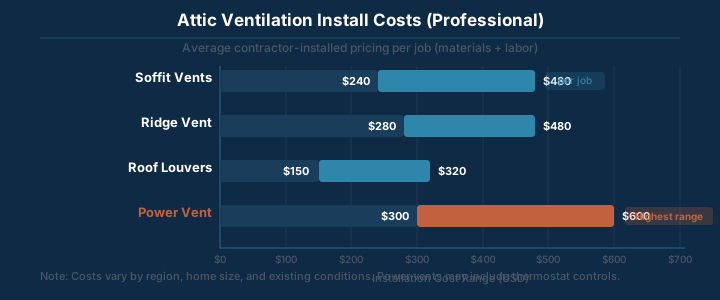
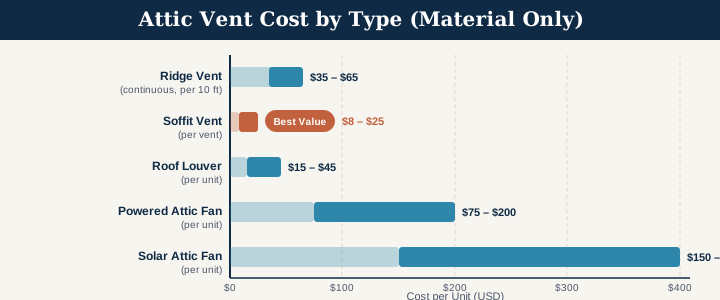
Material cost runs $0.75–$1.50 per lineal foot for the vent product itself (brands like Air Vent, Lomanco, or generic). Installed, expect $3–$5 per lineal foot including shingle cap labor. A 40-foot ridge vent run costs roughly $120–$200 in material and $280–$480 in labor, for a total of $400–$680 installed.
If you're replacing an existing metal box vent system with continuous ridge vent during a re-roof, the incremental cost is often $200–$400 for the whole job, since the roofer is already up there.
Soffit Vents (Individual)
Individual rectangular soffit vents (8"×16") cost $3–$8 per vent in material. Installed cost is $15–$30 per vent, including cutting the opening and fastening. For a typical house needing 12–16 individual soffit vents, that's $180–$480 total installed. It's labor-intensive in proportion to material because each vent requires its own cut.
Continuous Soffit Vent Strip
Material runs $0.50–$1.25 per lineal foot. Installed cost is $2–$4 per lineal foot. For 60 lineal feet of continuous soffit vent (typical for a 1,500 sq ft house), expect $120–$240 installed. The cut is longer but more efficient per unit of NFA than individual vents.
Gable Vents
A 14"×16" gable vent runs $20–$45 in material. Installed cost including the rough opening and trim is $80–$150 per vent. Most attics need only 2–4 gable vents, so total installed cost is $160–$600 depending on vent size and accessibility.
Power Attic Ventilators (PAV)
Electric-powered attic fans cost $80–$200 for the unit and $150–$400 for installation (wiring, mounting, weatherproofing). Solar-powered versions run $150–$350 for the unit with similar install costs. Total installed range: $300–$600 for electric, $350–$700 for solar.
Power ventilators are controversial. Many building scientists argue they create negative pressure that draws conditioned air from living spaces, negating any energy savings. The Department of Energy has moved away from recommending them in recent years. If you're considering one, talk to an energy auditor before spending the money.
Rafter Baffles (Vent Chutes)
If your soffit vents are blocked by blown-in insulation, baffles must be installed before venting makes any difference. Material cost is $1.50–$3 per baffle (one per rafter bay). Installed cost in an accessible attic is $3–$6 per baffle. For a house with 48-inch on-center rafter spacing and 80 lineal feet of eave, you'd need roughly 20 baffles, coming to $60–$120 installed if you can access them from the attic.
Full Installation Cost Scenarios
Here's what real installations typically cost for three house sizes, assuming a full system install (no existing ventilation worth keeping):
800 sq ft attic: smaller ranch or cape cod
Required NFA: 768 sq in (1/150 rule)
- 28 lineal feet of ridge vent: $140–$230
- 10 individual soffit vents: $150–$300
- Baffles if needed: $60–$100
- Total range: $350–$630
1,500 sq ft attic: mid-size single story
Required NFA: 1,440 sq in
- 36 lineal feet of ridge vent: $180–$300
- 60 lineal feet of continuous soffit vent: $120–$240
- Baffles: $80–$150
- Miscellaneous caps and caulk: $30–$60
- Total range: $410–$750
This is close to the $600–$1,400 range you'll see quoted for "typical" homes. The lower end reflects simpler roofs and favorable access; the upper end includes steep pitches, limited soffit space, and additional labor complications.
2,500 sq ft attic: larger two-story or colonial
Required NFA: 2,400 sq in
- 55–60 lineal feet of ridge vent: $280–$450
- 90 lineal feet of continuous soffit vent: $180–$360
- Baffles: $100–$200
- Total range: $560–$1,010
Larger homes often have more complex rooflines (multiple ridges, hips, dormers), which adds labor and may require supplemental off-ridge venting. Real-world quotes for 2,500+ sq ft homes can easily run $1,200–$2,000 if the roof is steep or multi-section.
Before getting quotes, run your own numbers with the attic ventilation calculator. Knowing your required NFA going in means you can verify that contractors are quoting enough vent material, not just enough to pass a visual inspection.
DIY vs Professional: Cost Difference
DIY attic ventilation is workable for soffit vent installation and rafter baffles. Cutting soffit vent openings requires a jigsaw, a drill, and a few hours. If you're comfortable on a ladder and in a crawlspace attic, you can add 12 individual soffit vents in a weekend for $80–$150 in materials.
Ridge vent installation is trickier. You need to cut a slot in the roof deck while on the roof, which requires confident footing, the right saw setup, and proper fall protection. Most homeowners should leave ridge vent installation to a pro. The savings ($200–$400 in labor) aren't worth the risk on a pitch of 5:12 or steeper.
Here's a rough comparison for a 1,500 sq ft attic:
| Task | DIY Cost | Pro Cost | Savings |
|---|---|---|---|
| 12 soffit vents | $90–$150 | $240–$480 | $150–$330 |
| Rafter baffles (20) | $40–$60 | $80–$150 | $40–$90 |
| 36 ft ridge vent | $55–$75 (material) | $280–$480 (full install) | Risk-adjusted; consider hiring |
| Full system combined | $185–$285 | $600–$1,110 | $415–$825 |
The DIY vs professional attic ventilation guide covers the specific skill requirements and safety considerations in more detail if you're on the fence.
When a Ventilation Upgrade Pays for Itself
The ROI question on attic ventilation is legitimate. Here's where the math works:
Shingle lifespan extension. Overheated attics (where summer temps can hit 150–160°F) cook asphalt shingles from below. Most shingle warranties include a ventilation compliance clause. Proper ventilation has been shown to reduce peak attic temperatures by 20–40°F, which can add 3–7 years to shingle life. On a 30-year architectural shingle roof that cost $8,000, every extra year of life is worth roughly $267. Seven years of extra life = $1,870 in deferred replacement cost.
Mold remediation avoided. Attic mold remediation typically runs $1,500–$5,000 for a moderate case, and full sheathing replacement can hit $8,000–$15,000. Proper ventilation that prevents moisture accumulation is a fraction of that remediation cost.
Summer cooling load reduction. A properly ventilated attic reduces heat gain into conditioned space below. The actual energy savings depend on your climate, ceiling insulation R-value, and AC efficiency, but studies cite reductions of 10–25% in attic-driven cooling load in hot climates. For a home spending $200/month on summer cooling, that's $20–$50/month, or $240–$600 per year.
At $600–$800 for a well-installed ventilation system, you're typically looking at payback in 2–4 years in hot climates, longer in mild ones.
Getting Accurate Quotes
When you call contractors, give them your attic square footage and ask them to quote based on meeting IRC R806.2 requirements. If they can't tell you the NFA their proposed system will deliver, that's a red flag.
Ask specifically:
- What is the total NFA of the exhaust vents you're installing?
- What is the total NFA of the intake vents?
- Are you installing rafter baffles where the insulation is blocking the eave space?
A contractor who answers those questions with real numbers is worth paying more for than one who just says "we'll install a ridge vent and a few soffit vents." You want someone who's sizing the system, not just adding a product.
Get at least three quotes. Ventilation work is competitive in most markets, and the spread between the high and low bid is often 40–60%. Knowing your required NFA from the ventilation requirements for your house size gives you a baseline to check whether anyone is cutting corners.
The ridge vent vs gable vent comparison is also worth reading before you finalize your system design, since the vent type you choose affects both the total cost and long-term performance of the install.
Get Your Exact Numbers
Use our free IRC R806.2 calculator to find your required net free area.
Open Calculator →Related Guides
DIY vs Professional Attic Ventilation: What to Know Before You Start
Some attic ventilation work is DIY-friendly. Other jobs aren't. Here's how to tell the difference, w…
Read guideRidge Vent vs Gable Vent: Which Is Better for Your Home?
Compare ridge vents and gable vents side by side, covering NFA ratings, installation costs, and whic…
Read guideAttic Ventilation Requirements by House Size: A Complete Guide
Find out exactly how much attic ventilation your home needs based on square footage, with real NFA c…
Read guide